Stunning clarity, lower power, rock-solid reliability – COB LED screens deliver brilliant performance that lasts.
Seamless surface technology eliminates pixel grain for buttery-smooth visuals and sleek aesthetics. With 0.9mm ultra-fine pitch delivering cinema-grade clarity, IP54-rated protection, and advanced thermal management, these displays maintain flawless performance 24/7—perfect for mission-critical environments like boardrooms and command centers.

500×500/1000mm Cabinet
P2.604, 2.976, 3.91 ,4.81
Front or Rear Dual Maintenance
COB (Chip on Board) revolutionizes LED displays by micro-assembling naked RGB chips onto PCB substrates. This direct-die integration achieves 0.4mm pixel pitches – impossible with conventional SMD – while eliminating 97% of solder joints for military-grade reliability.
(1) Pixel Density
With chips mounted flush to the board, COB achieves 8K resolution at 110″ viewing distances – perfect for corporate lobbies and surgical monitoring.
(2) Ruggedness
The epoxy-encapsulated design withstands 50G mechanical shock (vs SMD’s 5G rating) and IP6X dust/water ingress.
(3) Thermal Management
Copper-core PCB draws heat away from chips, sustaining <60°C at 10,000nit brightness for 100,000+ hour lifespan.
| Feature | COB LED Display | SMD LED Display | Selection Recommendation |
|---|---|---|---|
| Optimal Viewing Distance | 0.5m–5m (e.g., meeting rooms, exhibition halls) | 3m–∞ (e.g., stadiums, billboards) | Choose based on installation distance |
| Environmental Adaptability | High protection, suitable for precision indoor scenarios | Standard protection, widely applicable | For humid/dusty environments, choose COB; otherwise, SMD |
| Budget Consideration | 30%–50% premium | Cost-effective | For long-term use, choose COB; for short-term projects, SMD |
| Image Quality | No graininess, ideal for static or medical images | High brightness, ideal for dynamic content | For color-critical use, choose COB; for brightness priority, SMD |
| Maintenance Complexity | Rear access, modular replacement | Requires front access | For embedded installations, choose COB; for standard installs, SMD |


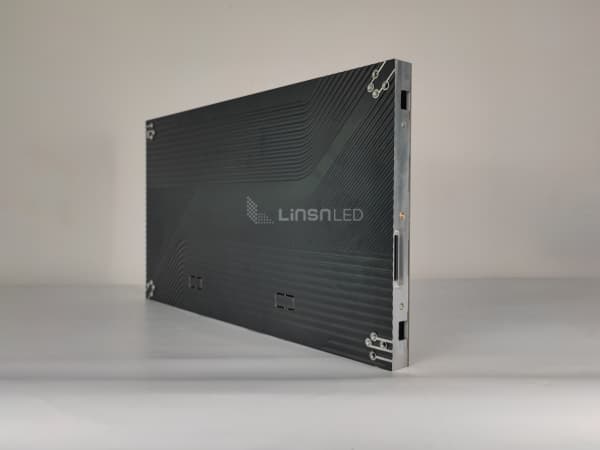
.jpg)
SMT LED Module Production
P0.9 COB Magnetic LED Module
How to Clean a COB LED Screen
| Pixel Pitch(mm) | P1.53mm | P1.86mm |
| LED | COB | COB |
| Module Resolution(dots) | 208*104 | 172*86 |
| Module Size(mm) | 320*160 | |
| Cabinet Resolution(dots) | 416*312 | 344*258 |
| Cabinet Size(mm) | 640mm*480mm*(WxH) | |
| Pixel Density(dots/pc) | 129792 | 88752 |
| Service ability | Full front service | |
| Protection Level(Front/Rear) | IP50 | |
| Weight | 7.5kg | |
| Grey Level (bit) | 14 | |
| Brightness(cd/㎡) | 650 | 750 |
| Contrast | 6000:1 | |
| Color Gamut | ≥90% NTSC | |
| Refresh Rate (Hz) | 3840 | |
| Vert. viewing angle | 140° | |
| Brightness Uniformity | ≥95% | |
| Pixel Pitch (mm) | P0.9375 | P1.25 | P1.56 |
| Pixel Configuration | COB | COB | COB |
| Module Resolution (Pixel) | 160*180 | 120*135 | 96*108 |
| Module Size (mm) | 150*168.75 | 150*168.75 | 150*168.75 |
| Scan Mode (Duty) | 1/60 | 1/60 | 1/64 |
| Cabinet Size (mm) | 600×337.5 | 600×337.5 | 600×337.5 |
| Cabinet Weight (KG) | 4.5 | 4.5 | 4.5 |
| Brightness (CD/㎡) | 400~600 | 400~600 | 400~600 |
| Viewing Angle (°) | 170 | 170 | 170 |
| Gray Grade (Bits) | 16 | 16 | 16 |
| Operation Power | AC100-240V 50-60Hz | AC100-240V 50-60Hz | AC100-240V 50-60Hz |
| Max. Power Consumption (W/㎡) | 450W | 450W | 450W |
| Avg. Power Consumption (W/㎡) | 270W | 270W | 270W |
| Frame Frequency (Hz) | ≥60 | ≥60 | ≥60 |
| Refresh Frequency (Hz) | ≥3,840 | ≥3,840 | ≥3,840 |
| Working Temperature (ºC) | -10~+60 | -10~+60 | -10~+60 |
| Lifetime (Hours) | 100000 | 100000 | 100000 |
Table of Contents
1. What Is a COB LED Display?
2. Core Advantages of COB LED Technology
2.1 What Is COB Packaging Technology?
2.2 Two Packaging Technologies
2.3 Core Technical Advantages
3. COB LED vs SMD vs IMD: What’s the Difference?
3.1 SMD Technology
3.2 IMD Technology
3.3 COB Technology
4. COB LED Pros and Cons: Is It Right for You?
4.1 Advantages of COB LED Display Screen
4.2 Limitations of COB LED Displays
4.3 Who Should Choose a COB LED Screen?
5. Where to Use COB LED Displays in 2025?
5.1 High-End Commercial Display & Retail
5.2 Corporate Meetings & Remote Collaboration
5.3 Public Infrastructure & Transportation Hubs
5.4 Entertainment & Creative Displays
5.5 Education & Professional Training
6. COB LED Future: Trends & Predictions
6.1 Micro COB Commercialization
6.2 XR Virtual Production & Immersive Content
6.3 Flexible & Custom Display Solutions
7. Conclusion
The COB LED display is one of the most notable breakthroughs in recent display technology.
Its key feature is directly mounting LED chips onto the circuit board, eliminating the traditional individual packaging step.
This design creates a perfectly flat screen surface with no visible pixel structure, resembling a single luminous glass panel.
In practical use, the most noticeable advantage is the incredibly fine and smooth image quality—pixels are virtually invisible even at close viewing distances.
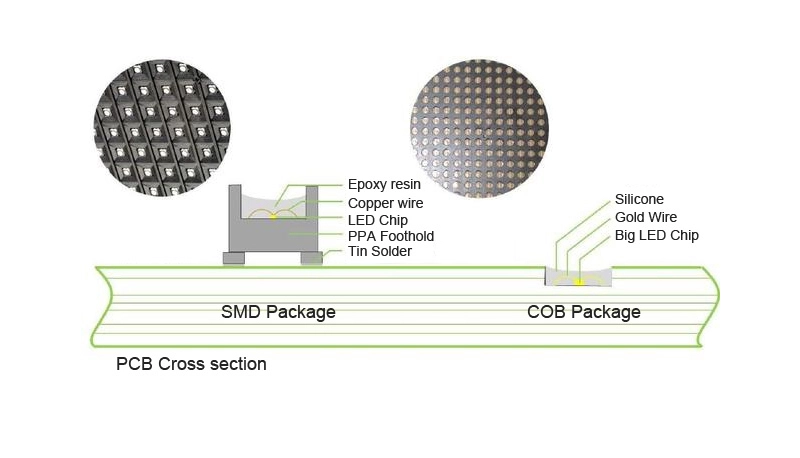
LED COB Vs LED SMD
At the heart of this technology lies precise manufacturing processes.
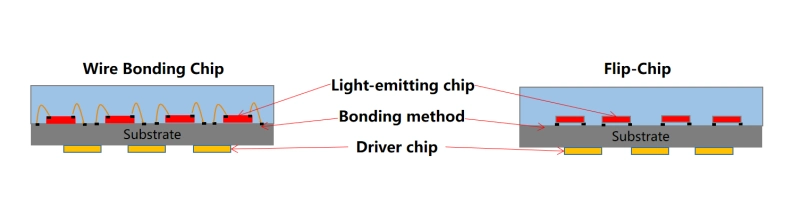
Multiple bare LED chips are bonded directly onto the circuit board using wire bonding or flip-chip techniques to establish electrical connections, then encapsulated with a highly transparent epoxy resin.
This advanced packaging method significantly improves LED density and luminance uniformity, while effectively eliminating the gaps and edge shadows typically associated with traditional LED displays.
The result is a visually seamless, high-performance display surface.

As an early form of COB packaging, wire bonding draws from traditional semiconductor techniques, using gold or aluminum wires to connect the chip to the substrate and form an electrical path.
Mature and stable: Proven manufacturing process with cost advantages, ideal for large-scale commercial applications.
Highly durable: Robust structure with strong resistance to impact and moisture, offering a longer lifespan than traditional LED displays.
Versatile: Suitable for environments with high demands on image quality and reliability, such as control rooms, commercial displays, and education settings.
As a more advanced evolution, flip chip technology eliminates the need for wire bonding. Chips are mounted upside-down directly onto the substrate, enabling shorter current paths and greater luminous efficiency.
Higher brightness: No wire obstruction allows for better light output and purer colors.
More energy-efficient: Delivers the same brightness with up to 20% less power consumption compared to wire-bonding solutions.
Ultra-slim design: Simplified structure makes it easier to achieve thinner, lighter displays, enabling more creative installation options.
Exceptional detail: Supports pixel pitches as fine as P0.7 and below, making it ideal for high-precision applications like premium meeting rooms, home theaters, and virtual production.
(1) Exceptional Brightness Uniformity
COB LED displays offer brightness uniformity of over 95%, significantly higher than the approximately 85% typically achieved by traditional SMD displays.
The continuous, seamless light-emitting surface effectively eliminates gaps between diodes and reduces the grid effect, delivering finer, more lifelike image details. This makes COB displays particularly well-suited for medical imaging, premium advertising, and other applications where image precision and clarity are critical.
(2) Exceptional Structural Stability and Lifespan
Encapsulated with epoxy resin, COB displays offer excellent resistance to fire, dust, and water, and can operate reliably in environments ranging from -30°C to 60°C.
(3) Outstanding Heat Dissipation
A low thermal resistance design combined with a high thermal conductivity PCB effectively manages operating temperature, preventing brightness degradation and color shift.
(4) Significantly Reduced Maintenance Costs
The modular design allows for individual module replacement in under 15 minutes, minimizing downtime and reducing overall operating costs.
(5) Wide Viewing Angle and High Contrast Ratio
Wide Viewing Angle: COB technology naturally supports a 178° horizontal and vertical viewing angle, thanks to its flat surface without protruding LED components.
High Contrast Ratio: With black mask encapsulation, seamless surface design, and anti-glare treatment, COB displays achieve a contrast ratio exceeding 10,000:1—far surpassing that of traditional SMD displays.
(6) Application Value and Market Outlook
As 8K and ultra-high-definition displays become mainstream, COB technology is emerging as a key solution for high-end applications. Its seamless, pixel-free visual performance is especially suited for precision-critical environments such as:
After years of development, fine-pitch LED display technology has evolved into a three-way competitive landscape dominated by SMD, IMD, and COB.
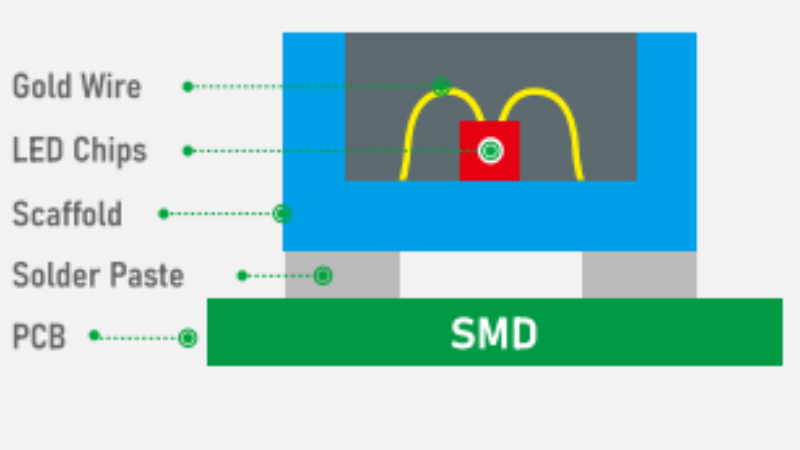
SMD is the earliest widely adopted technology, which involves soldering pre-packaged LED lamp beads onto a PCB. Its structure is relatively complex and is suitable for pixel pitches of 1.2mm and above.
The SMD process is mature and cost-effective, but its LEDs are prone to falling off, require frequent maintenance, and have relatively weak impact resistance, resulting in higher long-term operating costs.
IMD technology bridges the gap between SMD and COB solutions, featuring a compact design that integrates 2-4 LED chips in a single package.
This hybrid approach maintains the serviceability of SMD while dramatically enhancing structural integrity.
However, IMD’s packaging density is limited and struggles to meet the high demands of future ultra-high-definition displays such as 8K and 16K in ultra-fine pitches (e.g., P0.9 and below).
Moreover, IMD’s price approaches that of COB, yet its performance still falls short, placing it in a challenging market position.
COB’s seamless encapsulation technology fundamentally addresses two long-standing issues in traditional LED displays—pixel gaps and component detachment.
It has emerged as a core technology for fine-pitch and ultra-high-definition applications.
In particular, for ultra-fine pitches of P0.9 and below, COB offers unmatched advantages in pixel density and display uniformity.

A common misconception in the market is to regard IMD as a “cheaper version of COB.” In reality, IMD inherently suffers from color consistency issues.
The color shift observed from different viewing angles is noticeably greater in IMD products than in COB, a physical characteristic dictated by its packaging structure.

This critical difference is often overlooked or avoided by many manufacturers but is crucial for professional users.
For system integrators, maintenance convenience is a key consideration.
While SMD allows for replacement of individual LEDs—seemingly lowering maintenance costs—in practice, this requires specialized equipment and skilled technicians.
COB adopts a modular maintenance approach, where although the cost per module is higher, replacement efficiency is improved by 3 to 5 times, significantly reducing downtime losses.
This aspect is often ignored in the industry but is vital in determining overall operational costs.
Technical Comparison of COB, SMD, IMD, and GOB in LED Displays
Technology | COB (Chip on Board) | SMD (Surface-Mounted Device) | IMD (Integrated Mounted Device) | GOB (Glue on Board) |
Technical Approach | Advanced process eliminating traditional SMD steps; high difficulty | Mature and widely used process | Evolved from SMD; one package for multiple pixels | Protective coating applied to SMD modules |
Pixel Pitch | ≥ 0.4mm | ≥ 1.0mm | ≥ 0.6mm | ≥ 1.0mm |
Impact Resistance | Excellent (>20kg) | Limited (<2kg) | Moderate | Excellent |
Reliability / Stability | Excellent | Moderate | Fair | Excellent |
Maintenance | Complex | Easy | Easy | Relatively complex |
Contrast Ratio | High | Medium | High | Medium |
Heat Dissipation | Excellent | Medium | Medium | Poor |
Consistency | Improving across most brands; few are excellent | Excellent | Excellent | Poor |
Manufacturing Complexity | High | Low | Medium | Low |
Max Viewing Angle | 170°–179° | 170° | 160° | 170° |
The LED display market is undergoing a technological revolution, with COB emerging as the gold standard for premium visual solutions.
This groundbreaking technology delivers unprecedented pixel density and reliability, but its true value lies in how these technical advantages translate to real-world applications.
(1) Exceptional Visual Performance
This technology results in purer blacks, enhanced contrast, and accurate color reproduction—even in high ambient light.
Ideal for applications that demand premium image quality, such as broadcast studios, luxury retail, and high-end boardrooms.
(2) Superior Durability and Reliability
With no exposed solder joints or brackets, COB displays are highly resistant to physical impact, dust, and moisture.
This makes them perfect for 24/7 operations in public environments such as transportation hubs, hospitals, and metro systems, or even humid outdoor conditions.
(3) Ultra-Wide Viewing Angle & No Pixel Grain
Thanks to their seamless surface and precise pixel architecture, COB displays deliver stable brightness and color fidelity across a 170° field of view.
Even at close range, images remain sharp and uninterrupted—ideal for premium interactive installations.
(4) Energy Efficient & Thermally Optimized
COB’s integrated packaging minimizes light loss and improves efficiency—consuming around 20% less power than SMD for the same brightness.
The PCB also serves as a more effective heat sink, helping extend the display’s lifespan and maintain brightness over time.
(1) Higher Initial Cost
Due to its complex packaging process, COB is currently more expensive than traditional SMD—especially in pixel pitches below P1.2, where pricing can be 30–50% higher.
However, the long-term benefits—lower failure rate and reduced maintenance—often outweigh the upfront cost.
(2) More Challenging to Repair
In the event of a failure, COB modules are replaced as a unit, rather than repairing individual LEDs like SMD.
While this may sound costly, COB displays have an extremely low failure rate (typically <0.01%), so real-world impact is limited.
(3) COB LED vs SMD LED Brightness
COB displays typically achieve peak brightness levels of 1,500–2,500 nits.
While sufficient for most indoor and semi-outdoor uses, they may not match the 5,000+ nit brightness of high-end SMD outdoor displays, such as highway billboards under direct sunlight.
Businesses that demand top-tier visual quality:
Broadcast studios, premium showrooms, flagship retail stores, high-end meeting spaces.
Locations requiring long-term, stable operation:
Airports, train stations, banks, hospitals, or any 24/7 operational environment.
Installations with close-up or interactive viewing:
Educational touchscreens, museum exhibits, luxury hospitality, and smart meeting terminals.
If your project prioritizes short-term cost control or requires ultra-high brightness for outdoor use, traditional SMD or IMD technology may still be the more practical choice.
However, if overall cost-efficiency, visual performance, and reliability over the next 3–5 years are your main concerns, LED screen COB is clearly the superior option.
As LED technology continues to mature and production costs become more optimized, COB displays are emerging as an ideal solution across various industries.
Below are five key application areas to watch in 2025:
(1) Luxury Stores & Flagship Retail Spaces
With exceptional contrast, color purity, and fine pixel rendering, they can accurately showcase product details and textures—effectively reinforcing brand aesthetics and elevating the overall ambience of the space.
(2) 4K/8K Ultra-HD Advertising Screens
In premium locations like airports, upscale office buildings, and exhibition centers, COB supports ultra-fine pixel pitches (P0.9–P1.5), delivering smooth, crisp content without visible pixelation—making it ideal for high-end advertising campaigns targeting discerning audiences.


(1) All-in-One Meeting Displays & Smart Conference Rooms
COB LED displays feature low blue light output, anti-glare surfaces, and wide viewing angles—ensuring reduced eye strain during extended meetings.
Even from side angles, color consistency is well maintained.
(2) Telemedicine & Cross-Regional Collaboration
Medical imaging demands exceptional display accuracy.
With high-fidelity, low-deviation color reproduction, COB displays support remote diagnostics and the detailed analysis of X-rays, MRIs, and endoscopic images.
(1) Information Displays in Subways and Airports
In high-traffic, 24/7 environments, they provide exceptional reliability, along with resistance to dust, moisture, and physical impact.
This ensures long-term stable operation with minimal maintenance or downtime.
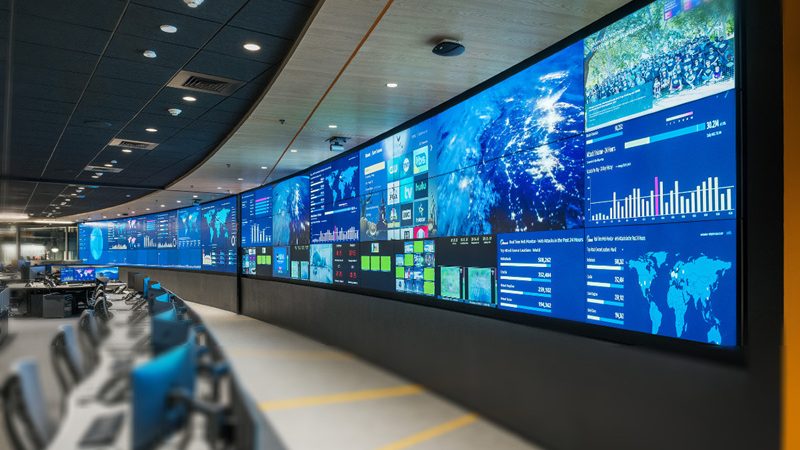
(2) Smart City Command Centers
When used in multi-screen control rooms, COB displays maintain seamless visual continuity with no visible bezels.
They can handle long-term display of high-intensity dynamic content without screen burn-in or color degradation—ideal for applications like traffic monitoring, public safety, and energy dispatching.

(1) Museums and High-End Exhibitions
LED displays offer soft, detailed visuals with high color accuracy.
When paired with HDR technology, they deliver lifelike tones and depth—faithfully recreating artwork while eliminating distractions like glare or pixelation, ensuring an immersive viewing experience.
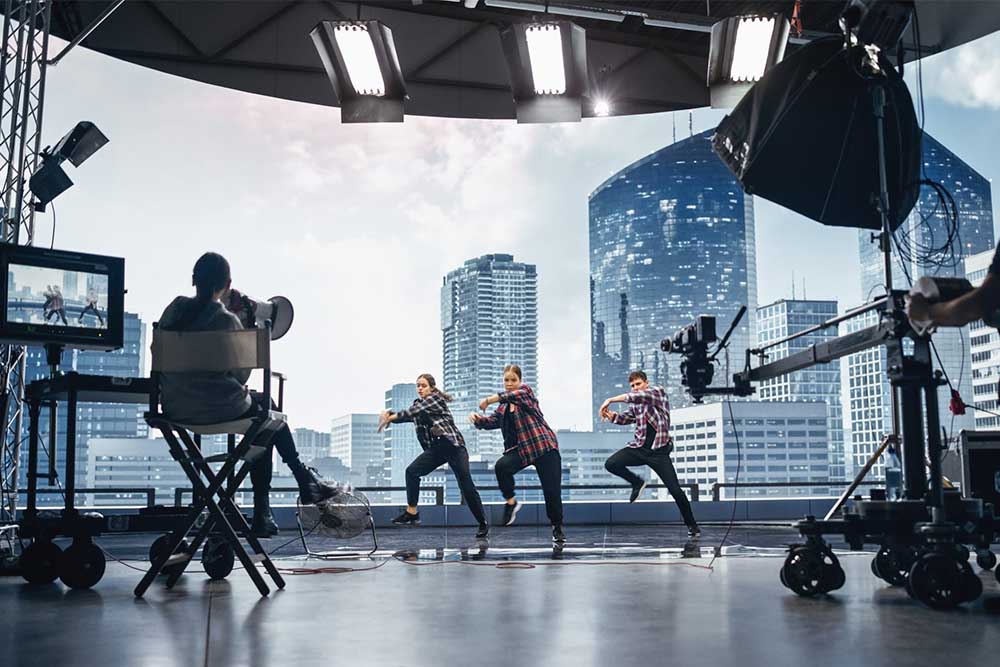
(2) XR Virtual Production & Film Studios
The film and advertising industries are rapidly adopting COB LED technology for building virtual production environments.
Its moiré-free output, high refresh rate, and low latency enable realistic, real-time filming and compositing—aligned with the future of digital content creation.

(1) Smart Classrooms and Interactive Boards
COB displays support anti-glare coatings and touch interaction, protecting students’ vision while offering a responsive and engaging learning experience.
They are increasingly replacing traditional projectors and electronic whiteboards.
(2) High-Fidelity Simulation Systems
For pilot, medical, and industrial training, COB’s high dynamic range (HDR) and accurate grayscale performance help create immersive virtual environments, enhancing realism and learning outcomes.
As packaging technology continues to advance and costs are further optimized, COB LED displays are entering a broader range of applications.
Here are three key trends to keep an eye on in 2025:
With finer pixel pitches and higher pixel density, Micro COB is gradually being adopted in high-precision display environments such as security monitoring and command centers—marking the next stage of COB LED technology evolution.
The growing demand for high refresh rates and low latency in film production and virtual studios is driving the adoption of COB LEDs.
These displays are expected to become a core component of next-generation XR systems.
Thanks to COB’s durability and encapsulation advantages, flexible and customized display formats are gaining popularity in creative exhibition spaces and retail windows—extending the use cases for COB LED screens beyond traditional formats.
If you’re seeking a LED display solution designed for close-up viewing, high usage intensity, and accurate color reproduction, a COB LED screen is a future-proof investment worth considering.
Before making a decision, it’s essential to evaluate your project’s specific needs and compare key differences between COB LED vs SMD technologies. your brand stand out in an increasingly competitive market.
Building 2, Hongfa High-tech Park, Shiyan Street, Baoan District, Shenzhen, China.
Email: sales@linsnled.com
Phone: +86-186-7583-4292
Ⓒ 2010-2026 All Rights Reserved by Shenzhen Linsn LED Co.,Ltd.


